
Sponsored Feature | In partnership with Yango
What if technology could tell when a driver is repeatedly driving unsafely before that behaviour becomes a serious incident.
A recent Yango Ride Safety Report offers an indication of what this approach can achieve. Between 2024 and 2025, reported reckless driving incidents across Yango’s African markets fell by 38%, from 13.05 to 8.08 incidents per million trips. The report links this improvement to updated driving-style analysis and speed-control measures.
But behind that figure is a more interesting development: the growing use of technology to make driving behaviour visible, identify patterns of risk and encourage safer journeys. And in Cameroon, some of these tools are already part of the Yango ride experience.
From speed limits to driving behaviour
Speed is one of the most obvious indicators of risky driving, but it is not the only one. A driver can remain within a speed limit while still accelerating sharply, braking suddenly, or making abrupt manoeuvres.
Yango’s safety technology looks at both.
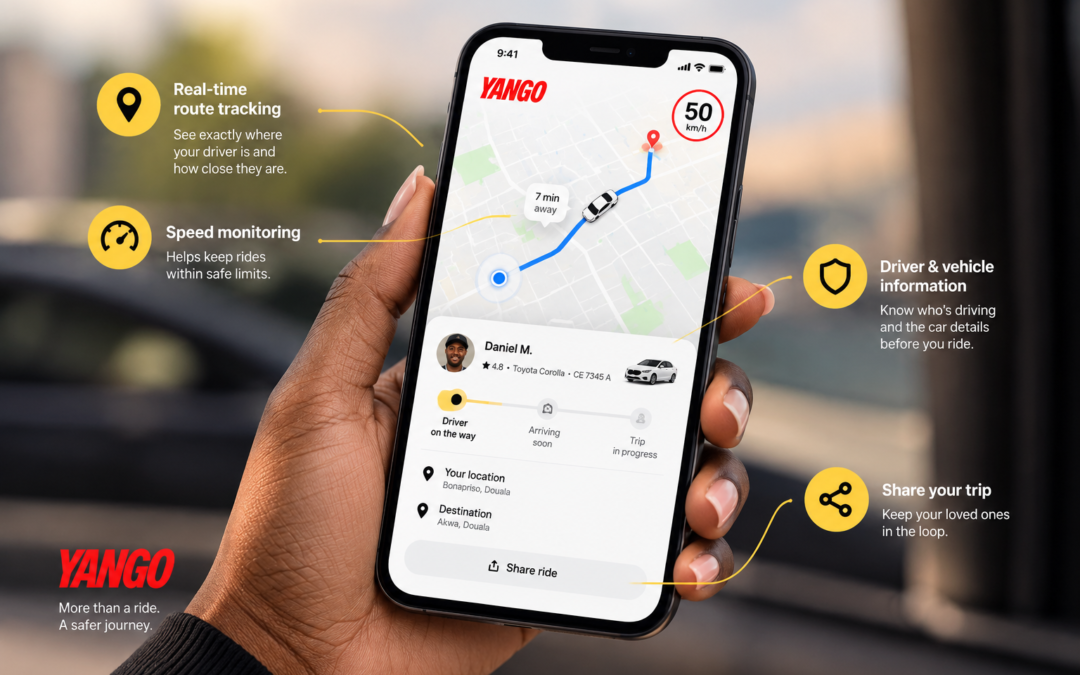
GPS speed monitoring can track a vehicle’s speed during a trip, while driving-style analysis uses information from the driver’s smartphone to identify behaviours such as sudden acceleration, harsh braking, and potentially unsafe manoeuvres. In Cameroon, the technology has been communicated as part of Yango’s local safety system, giving the platform another way to identify driving patterns beyond what can be observed from a single passenger report.
When repeated unsafe behaviour is identified, the system can trigger proportionate interventions, beginning with warnings and potentially leading to restrictions or removal from the platform.
This creates an important feedback loop. Instead of technology simply recording what happened during a trip, it can help identify behaviour that needs to change and give drivers an opportunity to correct it.
That approach also complements the role passengers play. After a trip, both the passenger and driver can provide feedback on each other, with that feedback contributing to their respective ratings.
Together, these tools create multiple points at which safety can be monitored: before the journey, through verification and anti-fraud controls; during the journey, through speed and driving-style monitoring; and afterwards, through ratings and feedback.
What this means for rides in Cameroon
For passengers using Yango in Cameroon, this means that safety is increasingly built into the technology behind an ordinary ride.
The platform’s local safety features include verified drivers, route sharing and in-app support, giving passengers tools to stay informed about their journey and seek assistance when necessary.
The addition of driving-style and speed monitoring adds another layer. A passenger may notice that a driver is speeding or braking sharply, but the platform can also use digital information generated during the trip to identify patterns of unsafe behaviour.
This is particularly relevant in busy urban environments such as Douala and Yaoundé, where traffic conditions can change quickly, and drivers constantly have to respond to different road situations. Technology cannot eliminate every road-safety risk, but it can make certain behaviours more visible and create a mechanism for intervention.
It also changes the conversation around road safety. Rather than relying only on reminders to “drive safely”, digital mobility platforms can use data to understand how journeys are actually being driven and encourage better behaviour over time. The 38% reduction highlighted in Yango’s Safety Report therefore points to more than an improvement in a regional safety indicator. It illustrates what becomes possible when technology is applied to one of the most persistent challenges in urban mobility: changing risky driving behaviour.
For Cameroon, where ride-hailing is increasingly part of everyday urban transport, the takeaway is straightforward. Safer mobility is not only about what happens on the road. It is also about what happens behind the app — how technology monitors journeys, identifies risk, gives drivers feedback, and gives passengers a role in creating a safer ride.
The road still belongs to the driver. But increasingly, technology is helping make safer driving part of the journey too.
About Yango Group
Yango Group is an international technology company headquartered in Dubai, dedicated to transforming global technologies into everyday services tailored to local communities. The company operates across more than 30 countries in Europe, the Middle East, Africa, Latin America, and other regions, offering services across mobility, delivery, entertainment, fintech, AI, and B2B solutions. Yango Group’s mission is to bridge global innovation with local expertise, empowering communities and improving everyday life through technology.